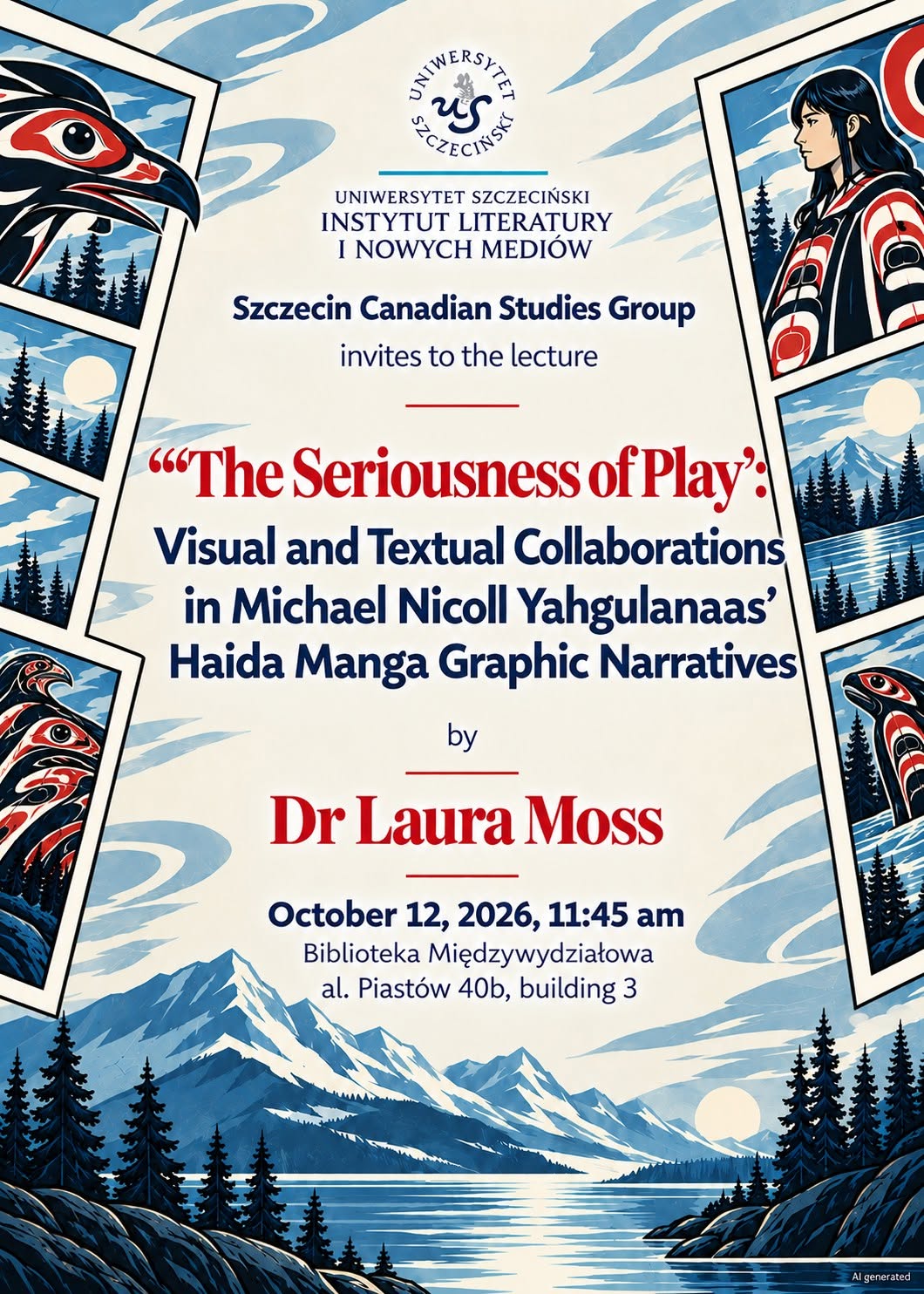
In his breakout graphic novel, Red: A Haida Manga (2010), Michael Nicoll Yahgulanaas’ (Haida nation) combines the traditional Indigenous frameline art form from the Pacific Northwest of Canada with Japanese manga style and Chinese calligraphy brushstrokes to tell a cautionary story about untethered revenge and the impact of war on the environment and community. The story ends with a call for a kind of restorative justice and an acknowledgement of complicity and communal responsibility. In Carpe Fin (2019), Yahgulanaas highlights the impact of a fuel spill on fish populations, of tsunamis on food sustainability, and the problems of the over-harvesting of sea lions, all while telling the story of a man abandoned in a half-life world, between human and animal, life and death. Together these graphic narratives take on histories of colonization, community justice, and environmental impact but they do so in the decidedly playful and beautifully elegant form of Haida manga. For Yahgulanaas, “Haida manga offers an empowering and playful way of viewing and engaging with social issues as it seeks participation, dialogue, reflection, and action.” In this lecture, I will situate Yahgulanaas’s work within the broad framework of both graphic narratives in Canada and within west coast art traditions before turning to look closely at his works. This artist is part of a long history of writers and artists in Canada who employ play into their form to raise serious issues. I ask, what if we approach visual and textual collaborations and juxtapositions methodologically as forms of cross-pollination, where the combination of words and images takes critical inquiry and creative practice further than either one might do singularly. As Yahgulanaas has said, “It is not a trifling matter, whether we’re talking about the Middle East or Canada trying to decolonize itself. But still we are emotional creatures, we like to laugh and play and smile and we haven’t necessarily made room enough for that.” This lecture will make room for us to explore these works together. No previous knowledge of these texts or contexts is required.
Dr. Laura Moss is Professor of Canadian and African literatures in the Department of English Language and Literatures at the University of British Columbia, Vancouver, Canada. She is the co-editor of the recent two-volume revised second edition of the complete history of literature in Canada, Canadian Literatures in English: Texts and Contexts (Broadview 2025, 2026). She has published articles and books on topics ranging from environmental futurism to public art monuments to narrative medicine to truth commissions in Canada and South Africa. Her most recent article “Is Oblique Solidarity Enough? Rethinking the 2024 (Scotiabank) Giller Prize Controversy” was published in Canadian Literature 264 (Spring 2026).